
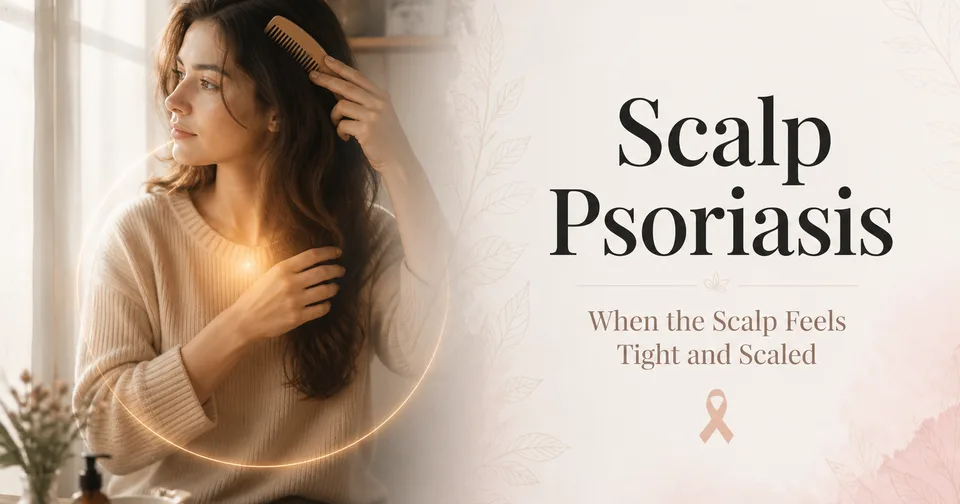
WHEN PLAQUES HIDE BENEATH THE HAIR
Scalp psoriasis can itch fiercely under the hair, shedding thick white or silvery scale onto collars while plaques march beyond the hairline onto the forehead or neck. Combing may hurt; styling products may sting; and people often feel trapped between wanting clean hair and fearing another painful wash day.
Because the scalp is both highly visible and hard to treat evenly, this form of psoriasis carries a special social weight. Flakes are mistaken for dandruff; redness at the hairline draws comments; and sleep suffers when itch peaks at night.
Clear diagnosis matters — seborrheic dermatitis and scalp psoriasis can overlap — and so does a care plan that respects both medical therapy and the person’s daily dignity.
Understanding the Condition
Scalp psoriasis is psoriasis localized to or dominant on the scalp, often with well-demarcated plaques and adherent scale. It may exist alone or with body plaques and nail changes. The Koebner phenomenon means scratching and harsh styling can extend involvement.
Medical care guides medicated shampoos, topical steroids or vitamin D analogues suited to hair-bearing skin, and systemic options when disease is severe. Infection and hair loss concerns deserve clinician review.
Homeopathy, as practiced in complementary care settings in Canada, is not a replacement for diagnosis, emergency care, or prescribed dermatologic treatment. It may be considered as individualized supportive care that listens to the whole person alongside conventional guidance when needed.
In scalp psoriasis, people often notice patterns such as:
- Thick scale that lifts with pain or pinpoint bleeding
- Itch that worsens under hats, heat, or stress
- Plaques crossing the hairline onto the face or nape
- Embarrassment about flakes on dark clothing
- Difficulty applying treatments evenly through dense hair
Understanding scalp psoriasis means treating the plaque biology and the practical challenge of hair-covered skin together.
People living with scalp psoriasis often benefit from a both-and approach: respect for medical diagnosis and treatment when needed, and space for individualized complementary support that takes sleep, stress, climate, and emotional load seriously. In Canada, this collaborative framing helps keep care realistic, ethical, and person-centered. Climate, occupation, and cultural skin ideals also shape how loudly scalp psoriasis is felt — a construction worker’s flare differs from a student’s, even when the label matches.
How It Feels — The Human Experience
Scalp psoriasis affects how people greet the world — hair parting, hat choices, and proximity in conversation all become negotiations.
Common human experiences include:
- Anxiety about flakes during meetings or dates
- Frustration with sticky or greasy medicated products in hair
- Sleep loss from nocturnal scalp itch
- Fear of permanent hair thinning
- Relief when a routine finally reduces scale without stripping the scalp
Supportive partners learn not to pick at scale and to honor medical appointments. Many people feel empowered by finding application techniques that fit their hair type and schedule.
Over months, many people notice that scalp psoriasis teaches unexpected skills: reading early warning signs, asking clearer questions in clinics, and protecting energy on difficult skin days. Those skills are part of recovery literacy, not proof that someone should “just cope forever” without help.
The Homeopathic Understanding — Supporting the Vital Force
Homeopathy approaches scalp psoriasis as vital-force expression through scalp plaques, itch modalities, and constitution, always alongside indicated dermatologic care.
In supportive care for scalp psoriasis, a homeopath may explore:
- Quality of scale and degree of burning versus itching
- Worse from washing, warmth of bed, or cold dry air
- Emotional themes tied to appearance and chronicity
- Concurrent body plaques, nail signs, or joint stiffness
- Overall reaction to stress and sleep quality
Remedies are individualized. The aim is gentle support — never replacement of prescribed scalp therapies.
Two people with the same label may receive different remedies because their modalities, thermal nature, and life story differ. That individuality is the method — not a delay tactic, and not a promise of cure. Follow-up visits matter: as sleep, season, and stress shift, the symptom picture of scalp psoriasis may shift too, and prescribing should remain responsive rather than rigid.
Commonly Considered Remedies
The following remedies are sometimes considered in homeopathic practice when the symptom picture matches. This list is educational and not a prescription:
- Sulphur — when burning scalp itch worsens with heat and washing
- Graphites — when sticky, cracking scale and oozing appear at the hairline
- Mezereum — when thick crusts form over sensitive scalp skin
- Arsenicum Album — when anxious restlessness and burning accompany dry scale
- Natrum Muriaticum — when greasy-dry contrast and emotional reserve feature
- Vinca Minor — when offensive, matted scalp eruptions appear in the picture
(All remedies must be individualized by a qualified homeopath. Self-prescribing for chronic or serious concerns is not advised. Continue any medically necessary care unless your physician advises otherwise.)
Gentle Daily Care
Scalp-specific gentle care:
- Follow clinician instructions for medicated shampoos and leave-on treatments
- Comb gently; avoid picking scale that can worsen plaques
- Use lukewarm water; pat, do not rub aggressively
- Choose soft headwear and breathable pillowcases
- Space harsh chemical treatments (bleach, tight braids) during active flares
- Seek care for pus, fever, rapid hair loss, or facial spread
Patience and precision beat forceful scrubbing every time.
Keep a simple weekly note of triggers, sleep, and what eased symptoms — not as self-blame, but as useful data for your physician and homeopath. Small patterns often become visible only when written down.
A Closing Reflection
Scalp psoriasis lives where identity and biology meet — hair, flakes, itch, and pride. Beneath the plaques, the vital force seeks balance. Supportive homeopathic care listens for that intelligence while medical therapies calm inflammation on hair-bearing skin.
Healing, in this complementary sense, is invited through recognition, gentle technique, and skilled listening. With attentive care, many people find quieter scalps and freer mornings.


Leave a Reply