
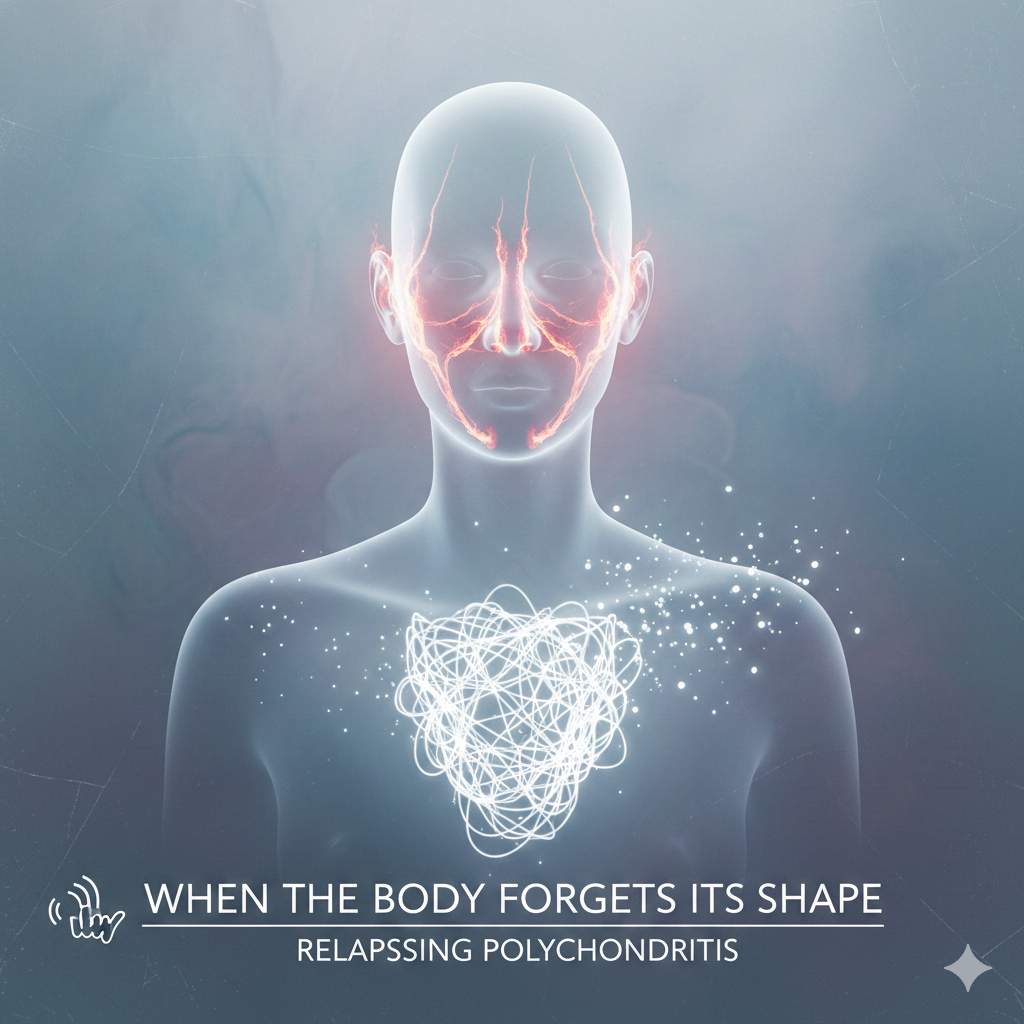
When the Body Forgets Its Shape: Understanding Relapsing Polychondritis
There are illnesses that arrive quietly, gently, almost like a whisper — and then persist, asking for attention in ways the world cannot see.
Relapsing Polychondritis (RP) is one of these — a rare autoimmune disorder where the body’s own cartilage becomes a target of misdirected defense.
It may begin subtly: a tender ear that reddens and swells, a nose that aches, joints that feel inflamed without obvious cause.
Sometimes the symptoms come in flares, leaving periods of relief in between, like the body breathing and then holding its breath again.
Though rare, this condition can affect the ears, nose, joints, eyes, and even the airways — making everyday life unpredictable.
Living with RP is often a journey in patience, in listening to the body, and in learning to honor its signals.
Understanding the Condition
Cartilage is the body’s soft scaffolding — shaping the ears, nose, joints, and airways.
In Relapsing Polychondritis, the immune system mistakenly attacks these structures, causing inflammation, pain, and tenderness.
Symptoms often appear in cycles:
- Swelling, redness, and warmth of the ears or nose
- Joint pain or stiffness, sometimes fleeting, sometimes persistent
- Eye inflammation, leading to redness or sensitivity
- Fatigue and malaise that linger even between flares
Sometimes the inflammation can involve the airway or heart, making medical care essential.
But beyond the clinical picture, there is a deeper story — one of the body’s defenses misfiring, a system that tries to protect but ends up hurting itself.
How It Feels
Living with RP is living with uncertainty.
One day, the ears may ache, the joints throb; the next, relief arrives like a quiet breath.
Pain can be sharp, dull, or throbbing, often coming and going unpredictably.
Fatigue accompanies the flares, leaving the body heavy, even as the mind struggles to remain active and present.
Emotionally, it can feel isolating. Few understand the invisible nature of this illness, and the unpredictability can create anxiety or worry about the future.
Yet, many people with RP develop a keen sensitivity to their own bodies — learning to notice the first whispers of inflammation, to respond gently, and to pace life according to its rhythms.
Why It Happens
Relapsing Polychondritis is an autoimmune condition.
The immune system — normally a protector — mistakenly attacks the body’s own cartilage and connective tissue.
The cause of this miscommunication is not fully understood, but genetic, environmental, and immune factors likely play a role.
The flares are a sign of the body overreacting — defending, protecting, but in the wrong direction.
It is not a failure of the body, nor of the person — it is a misdirected message, asking for attention, care, and gentle intervention.
The Homeopathic Understanding: Listening to the Body’s Misguided Fire
Homeopathy views RP not only as a physical illness but as a deeper disturbance in the body’s internal communication — where protection has turned into aggression.
The goal is to help the body remember balance, to calm the overactive defenses, and to restore a rhythm that allows healing without attack.
Remedies often considered include:
Arsenicum Album – for restlessness, anxiety, and weariness during flares; supports overall resilience.
Rhus Toxicodendron – for joint stiffness, swelling, and pain that improve with gentle motion.
Bryonia Alba – for pain aggravated by movement, with desire for rest and quiet.
Calcarea Fluorica – for cartilage inflammation, ear or nose tenderness, and slow healing of connective tissues.
Apis Mellifica – for redness, swelling, and burning pain, often in ears or joints.
Each case is unique, chosen based on the person’s emotional, physical, and energetic patterns, not only lab results.
(Always consult a qualified homeopath for personalized guidance.)
Gentle Daily Care
Listen to your body. Rest during flares without guilt; overexertion can worsen inflammation.
Protect sensitive areas. Avoid pressure on ears, nose, or inflamed joints; gentle clothing and cushioning help.
Support the immune system. Nutritious meals, hydration, and gentle exercise can strengthen overall resilience.
Soothe inflammation. Warm compresses, gentle massage, and mindful stretching can relieve discomfort.
Prioritize emotional calm. Stress can trigger or worsen flares; meditation, journaling, or quiet reflection support balance.
Work closely with medical care. Because RP can affect airways or heart structures, coordinating with physicians ensures safety alongside holistic approaches.






Leave a Reply