
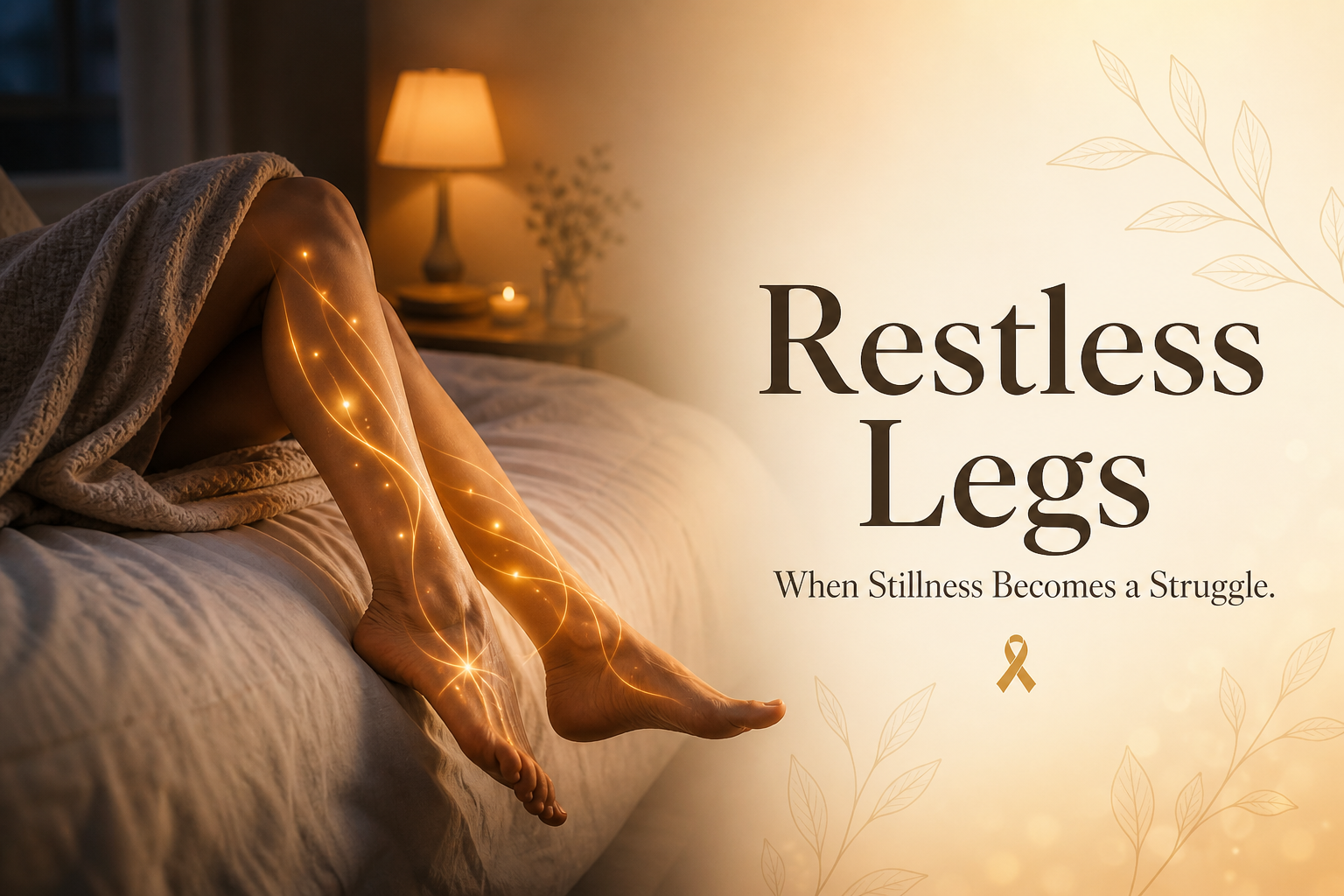
When Stillness Becomes a Struggle.
Some discomforts do not shout.
They whisper, tug, and return again and again, especially when the world grows quiet.
Restless Legs Syndrome is one of these experiences.
It appears most often at night, just as the body is preparing to rest, turning stillness into struggle.
There is an urge to move that feels impossible to ignore.
A crawling, pulling, aching, or electric sensation deep within the legs.
Relief comes only with motion — walking, stretching, shifting — and disappears the moment stillness returns.
Sleep, which should restore, becomes interrupted and fragile.
This is not impatience.
It is not imagination.
It is the body asking for something it has not yet received.
Understanding What Is Happening
Rest is not only physical.
It is neurological, emotional, and deeply instinctive.
In Restless Legs Syndrome, the nervous system remains unsettled.
The body does not fully switch into rest mode.
Signals continue to fire, creating discomfort when movement stops.
This often worsens in the evening or at night, when external distractions fade and the body’s inner rhythms take center stage.
The stillness exposes what has been held inside all day — tension, depletion, strain, or imbalance.
The legs respond because movement has become the body’s way of coping.
How It Feels
Living with Restless Legs Syndrome can be exhausting in ways that are difficult to explain.
There is frustration at bedtime.
A sense of dread when lying down.
Interrupted sleep that leaves mornings heavy and unrefreshed.
Some feel embarrassed by the constant need to move.
Others feel misunderstood, told to “just relax” when relaxation is exactly what feels unreachable.
Over time, fatigue builds.
Patience thins.
The body feels tired, but never truly rested.
This condition affects more than legs.
It affects mood, focus, resilience, and emotional balance.
Why the Body Responds This Way
From a homeopathic perspective, Restless Legs Syndrome reflects a disturbance in the vital force affecting nerves, circulation, and rest rhythms.
It may arise from:
- Nervous sensitivity
- Emotional strain or prolonged stress
- Physical depletion
- Hormonal shifts
- Inherited tendencies
- Long-standing tension held in the body
At its core, the body is struggling to transition from activity to rest.
Movement becomes a form of relief — not because the body wants activity, but because stillness feels unsafe or uncomfortable.
This is not a flaw.
It is a signal.
The Homeopathic Understanding: Inviting Rest Back In
Homeopathy does not attempt to silence symptoms.
It listens to them.
The goal is to restore balance to the nervous system so the body can once again tolerate stillness without distress.
Remedies are selected based on the individual’s sensations, emotional state, sleep pattern, and overall constitution.
A trained homeopath may consider:
- Rhus Toxicodendron – when restlessness improves with movement and worsens during rest
- Zincum Metallicum – when constant leg movement accompanies nervous exhaustion and mental fatigue
- Arsenicum Album – when restlessness is paired with anxiety, especially at night
- Calcarea Carbonica – when weakness, heaviness, and insecurity accompany nighttime discomfort
- Cuprum Metallicum – when cramping or twitching sensations disturb rest
Each remedy addresses a specific pattern, not just the symptom.
Gentle Daily Support
The body learns rest gradually.
Establish a consistent bedtime routine.
Allow the evening to slow naturally.
Gentle stretching before bed can ease physical tension.
Warmth often soothes — warm socks, a blanket, a calm environment.
Avoid forcing stillness.
When movement is needed, respond without frustration.
Resistance only increases tension.
The nervous system settles when it feels respected.
Living with Patience and Trust
Restless Legs Syndrome teaches a quiet lesson about the body’s need for balance.
It is not asking for control.
It is asking for understanding.
Your body is not working against you.
It is communicating through sensation when words are not enough.
With compassionate care, individualized homeopathic support, and patience, the body can relearn rest.
Stillness can become safe again.
Sleep can deepen, slowly and naturally.
Healing does not arrive through force.
It arrives when the body feels heard — and allowed to rest at last.


Leave a Reply