
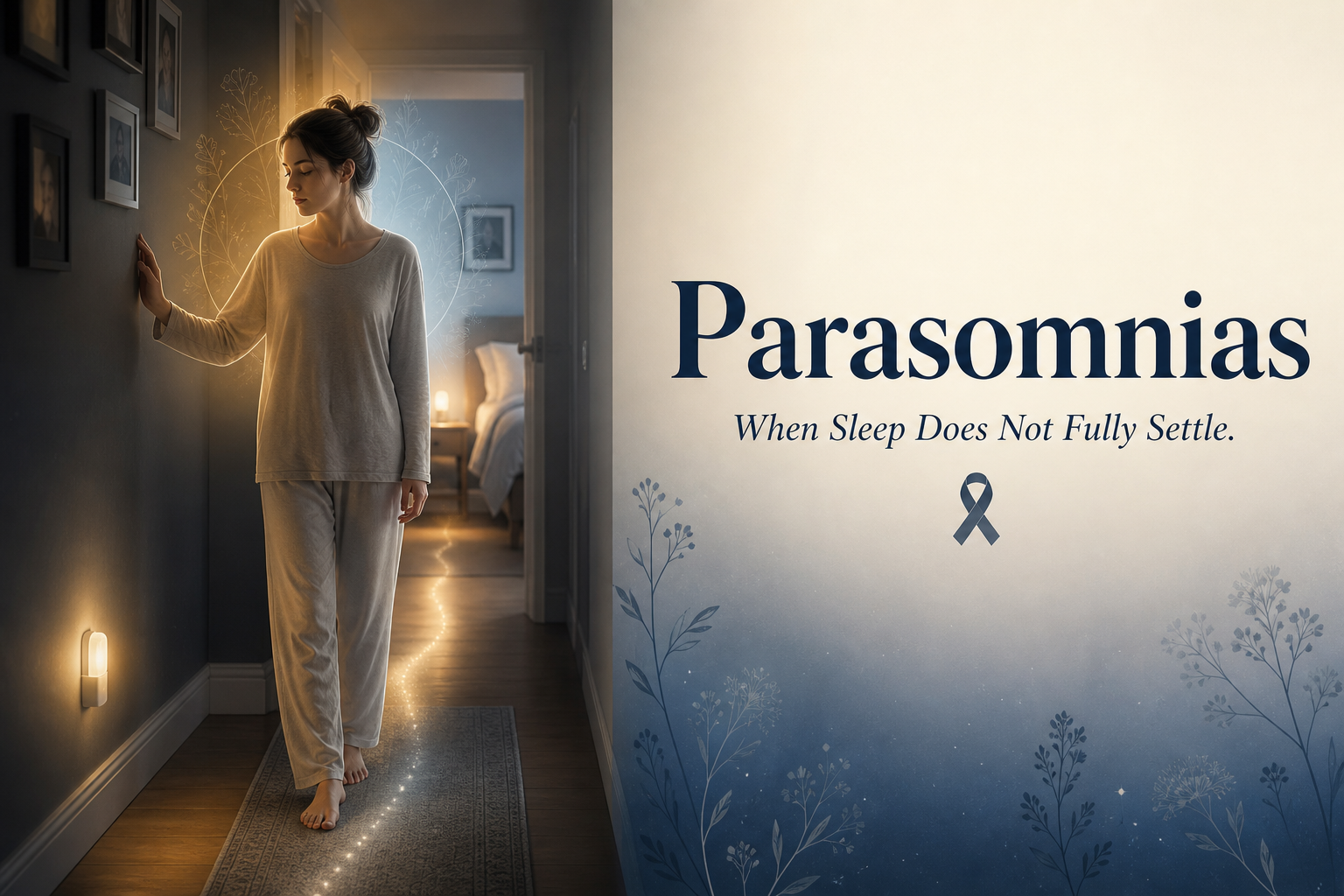
When Sleep Does Not Fully Settle.
Some nights do not rest the way they should.
They move.
They stir.
They carry the body into places the waking mind never planned to go.
Parasomnias are not chosen.
They are not imagined.
They are moments when sleep becomes unfinished, when the body drifts between rest and alertness, unable to settle fully into either.
A person may walk, speak, cry out, or move while still asleep.
They may wake with a racing heart, or not wake at all, learning only later what the night held.
Sleep, which should feel safe, begins to feel uncertain.
Understanding What Is Happening
Sleep is a surrender.
For it to be deep, the body must feel protected.
With parasomnias, part of the nervous system remains watchful.
The mind loosens its grip, but does not release completely.
The body rises to fill that gap, acting out what has not yet found peace.
This often follows stress, emotional shock, fear, exhaustion, or long-held tension.
Sometimes it begins quietly in childhood.
Sometimes it appears later, after life has demanded more than the system could easily hold.
The body is not misbehaving.
It is guarding itself.
How It Feels to Live This Way
Living with parasomnias can be lonely.
There may be shame in behaviors you do not remember.
Fear of sleeping away from home.
Worry about what might happen once your eyes close.
Mornings may begin with fatigue instead of renewal.
With questions instead of clarity.
With a sense that rest is never complete.
For children, the fear may be wordless.
For adults, it may be carried quietly, without explanation.
None of this means you are weak.
It means your nervous system has learned to stay alert — even in the dark.
Why the Body Responds This Way
From a homeopathic understanding, parasomnias arise when the vital force is unsettled.
The inner rhythm that guides sleep, safety, and release becomes disturbed.
Unprocessed emotions, fear, grief, trauma, or prolonged stress may remain active beneath the surface.
When waking control softens at night, these impressions emerge through movement, sound, or sudden arousal.
The body is not recreating danger.
It is trying to discharge it.
Homeopathy and the Language of Sleep
Homeopathy listens before it acts.
It does not label the night as wrong.
It listens to how the body speaks during it.
Remedies are chosen based on the individual — their fears, their dreams, their emotional landscape, their life story.
A trained homeopath may consider:
- Stramonium when sleep is filled with terror, panic, or sudden fright
- Belladonna when episodes are intense, sudden, and dramatic
- Chamomilla when irritability and restlessness disturb rest
- Coffea Cruda when the mind cannot quiet, even in sleep
- Calcarea Carbonica when sleep is disturbed by insecurity and inner tension
These remedies do not force sleep.
They invite the nervous system back toward trust.
Gentle Support Beyond Remedies
Safety heals sleep.
A calm bedtime.
Soft lighting.
Reassurance without alarm.
Regular routines that tell the body it is allowed to rest.
After an episode, comfort matters more than explanation.
The nervous system learns peace through presence, not correction.
Sleep returns when vigilance is no longer needed.
Living with Compassion
Parasomnias are not a failure of sleep.
They are a sign that something within needs tenderness.
Your body has learned to stay awake for a reason.
Healing begins when it is shown — again and again — that rest is safe now.
There is no need to rush this process.
Sleep remembers how to heal when the body feels understood.
With patience, gentle care, and respect for the body’s wisdom, the night can soften.
And rest can slowly return — quiet, deep, and whole.

Leave a Reply