
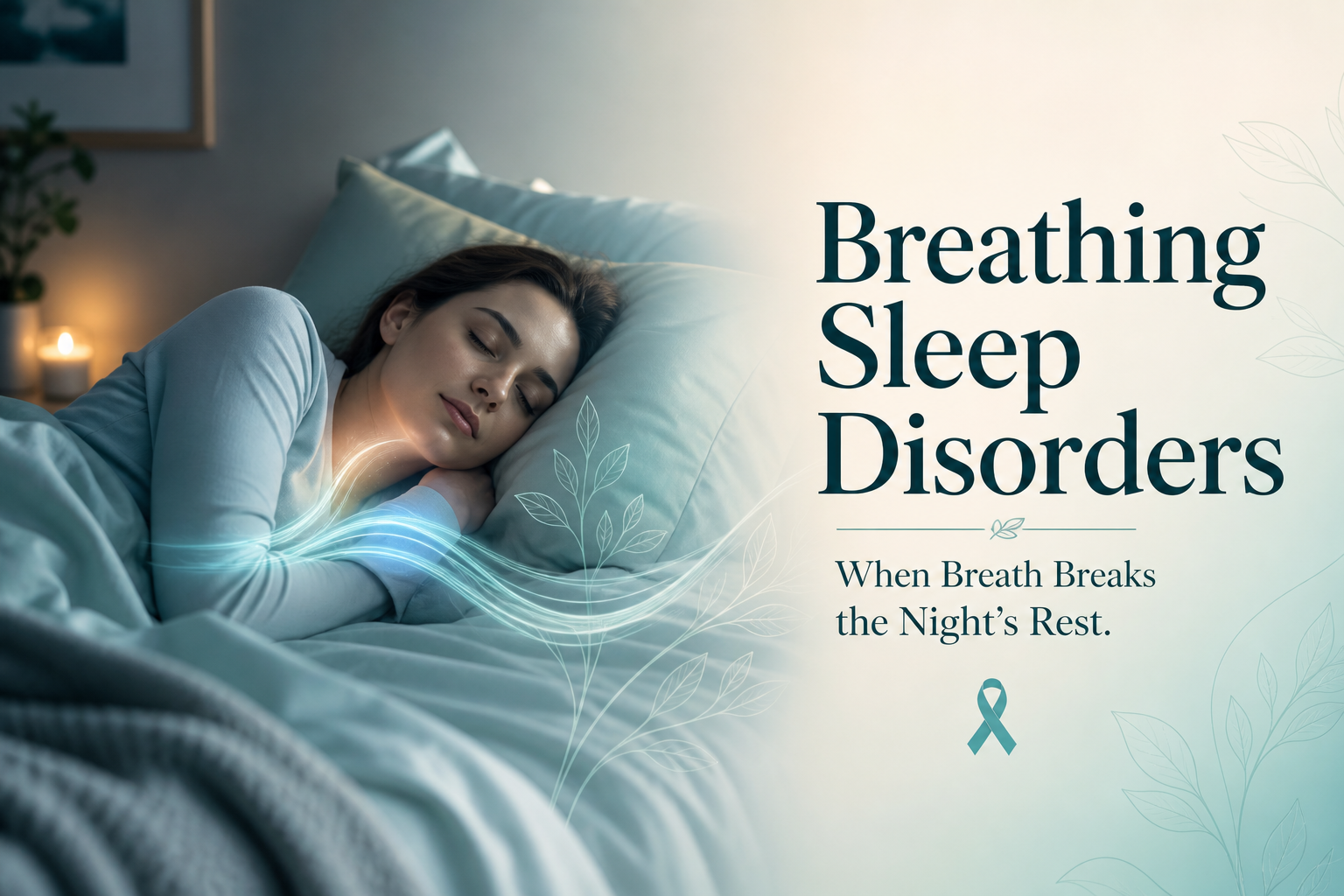
When Breath Breaks the Night’s Rest.
Some nights arrive as if the body cannot fully rest, even when the mind is still.
Breathing-related sleep disorders are not laziness.
They are not choice.
They are the body signaling that the flow of life — the rhythm of breath, the cycle of sleep, the restoration of energy — is disrupted.
At first, it may seem like occasional snoring, slight pauses in breathing, or restless sleep.
But over time, the body struggles to maintain oxygen balance, heart rate, and energy levels.
Sleep becomes fragmented.
Daytime fatigue, irritability, and difficulty concentrating quietly settle in.
Even when the bed is warm and still, the body feels unrested.
Understanding the Experience
Breathing is life.
When it is disrupted during sleep, the body’s natural restoration cannot fully occur.
Breathing-related sleep disorders include conditions like:
- Obstructive Sleep Apnea (OSA) — pauses in breathing due to airway obstruction
- Central Sleep Apnea — disruption of the brain’s signaling to breathe
- Hypoventilation or oxygen fluctuations during sleep
The body responds with fragmented rest, stress on the cardiovascular system, and constant low-level fatigue.
This is not weakness.
It is a signal that the body needs support, attention, and gentle care.
How It Feels
Living with a breathing-related sleep disorder can feel like moving through fog, both day and night.
There may be loud snoring or gasping that wakes the sleeper or others nearby.
Nighttime restlessness, headaches, or dry mouth may be present.
During the day, fatigue, irritability, and difficulty focusing are constant companions.
There may be anxiety about sleep itself, fear of not getting enough rest, or worry about health consequences.
Yet beneath the exhaustion, the body is resilient.
It continues to signal, protect, and adapt, even when the rhythm is disrupted.
Why It Happens
From a homeopathic perspective, breathing-related sleep disorders reflect a disturbance in the vital force — the body’s natural rhythm of restoration, oxygenation, and energy balance.
This may arise from:
- Anatomical variations or airway restrictions
- Chronic inflammation or respiratory sensitivity
- Nervous system imbalance
- Emotional or physical stress
The body expresses imbalance through disrupted sleep and breathing.
It is not a failure — it is a protective response.
The Homeopathic Understanding: Restoring Flow
Homeopathy addresses the person, not only the symptom.
It listens to the emotional, physical, and constitutional patterns that contribute to the disorder.
The goal is to support the vital force so the body can regulate breathing, rest deeply, and restore energy naturally.
Some remedies a trained homeopath may consider include:
- Arsenicum Album – for anxiety, restlessness, and shallow breathing during sleep
- Phosphorus – for sensitivity, respiratory weakness, and fatigue
- Nux Vomica – when fatigue follows overwork, stress, or digestive tension
- Kali Bichromicum – for thick mucus, snoring, and airway obstruction
- Calcarea Carbonica – for respiratory weakness, fatigue, and body congestion
Remedies are individualized, chosen according to the person’s constitution, triggers, and patterns.
Gentle Daily Care
Healing begins with attention and compassion:
- Maintain a sleep-friendly environment — quiet, cool, and calm
- Sleep on positions that ease breathing, often elevated or side-lying
- Practice gentle breathing exercises or relaxation before bed
- Avoid substances that irritate the airways, like smoke or heavy alcohol
- Rest without judgment; the body is doing its best
Fragmented sleep improves gradually when rhythm, care, and support are present.
Living with Awareness and Compassion
Breathing-related sleep disorders are not laziness.
They are the body’s signal to listen and nurture.
You are not failing.
You are adapting to a rhythm that needs support.
Healing is not forcing sleep or breath.
It is listening, nurturing, and restoring flow — step by step, breath by breath.
Every quiet night, every moment of calm, is a step toward rhythm.
Slowly, the body learns to rest deeply, breathe freely, and live fully — gently, patiently, and deeply human.


Leave a Reply