
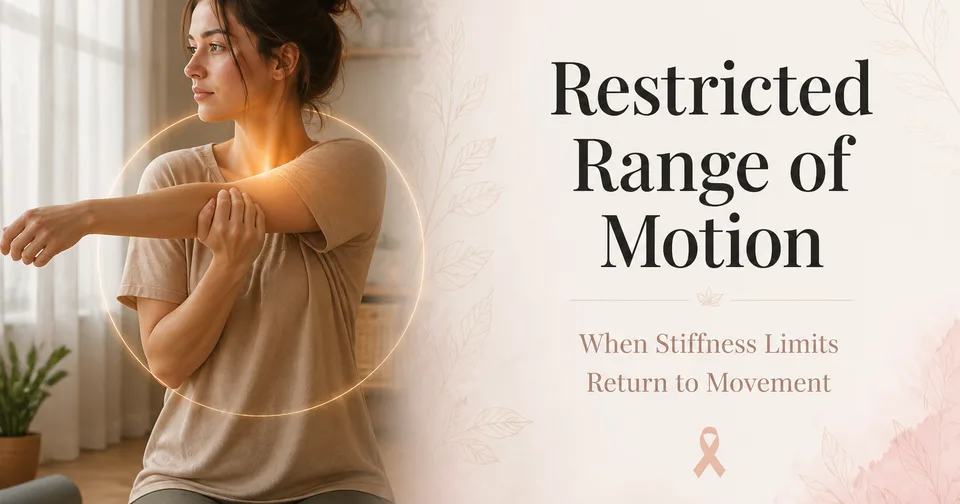
WHEN THE ARC OF MOVEMENT NARROWS
Restricted range of motion after trauma is the joint’s reduced vocabulary—flexion that stops early, rotation that will not complete, reach that no longer finds the top shelf. Swelling, pain, fear, capsular tightness, and scar can all shrink the arc. Function suffers in proportion: socks, driving checks, sport, and work tools demand degrees you temporarily do not own.
Medical timelines matter. Homeopathy may support comfort as complementary care while mobility work proceeds.
Understanding the Condition
Loss of range may be expected after immobilization or significant injury; sudden loss with locking suggests mechanical block needing assessment. Hot swollen joints with fever, neurological loss, or rapidly worsening stiffness with colour changes need prompt medical review.
Physiotherapy typically uses frequent gentle mobility, swelling control, and progressive strengthening in available range. Forcing through sharp pain can inflame and set back progress.
In Canada, timely medical evaluation remains essential when red-flag signs appear: severe or rapidly worsening pain, numbness or weakness, loss of bowel or bladder control, chest pain or breathing difficulty, signs of infection, unexplained swelling that spreads, deformity, inability to bear weight, or any sudden neurological change. Homeopathy may be considered only as complementary, individualized supportive care alongside diagnosis, emergency assessment, imaging, physiotherapy, or other treatments recommended by a qualified physician. It is not a substitute for standard medical care and is not described here as a cure.
People living with restricted range of motion often notice patterns such as:
- A firm stop before the pre-injury end range…
- Morning restriction that eases slightly with warmth…
- Compensation from neighbouring joints…
- Fear at the edge of available motion…
Holding both the tissue story and the person’s whole context helps care feel more precise and more humane.
How It Feels — The Human Experience
Restricted range is measurable, which can motivate or demoralize. People become amateur goniometers, celebrating single degrees or despairing at plateaus. Social tasks reveal limits before private ones do—waving, dressing in gyms, kneeling in worship or play.
Common human experiences include:
- Impatience with slow degree gains…
- Fear of forcing damage…
- Embarrassment in group exercise settings…
- Irritation when swelling erases yesterday’s progress…
- Pride photographing a newly possible gesture…
Loved ones can help by listening without minimizing, offering practical support with daily tasks, and respecting the injured person’s pace. Recovery is not only about tissues knitting; it is also about restoring trust in movement.
The Homeopathic Understanding — Supporting the Vital Force
Homeopathy individualizes restricted range pictures by whether motion helps or harms, and by the emotional forcing or avoiding style of the person.
In supportive care for restricted range of motion, a homeopath may explore:
- Stiffness worse after rest versus worse after overactivity
- Warmth preference before mobility
- Pain quality at the end of range
- Restless desire to stretch versus fear of moving
- Sleep positions that stiffen overnight
Two people with the same injury label may receive different remedies because their lived picture differs. The intention is gentle support of the vital force’s ordering intelligence—never force, never one-size-fits-all prescribing, and never a claim to cure conditions that require ongoing medical management.
Commonly Considered Remedies
The following remedies are sometimes considered in homeopathic practice when the symptom picture matches. This list is educational and not a prescription:
- Rhus toxicodendron — commonly considered when motion eases stiffness after initial pain.
- Bryonia alba — matched when motion aggravates and rest is needed.
- Causticum — sometimes discussed in contracture-like restriction pictures—individualized.
- Ruta graveolens — explored when fibrous tissues feel strained and stiff.
- Arnica montana — considered when traumatic soreness limits willingness to move.
(All remedies must be individualized by a qualified homeopath. Self-prescribing for chronic or serious concerns is not advised. Continue any medically necessary care unless your physician advises otherwise. Homeopathy in Canada is complementary supportive care and is not presented here as a cure.)
Gentle Daily Care
Daily care is frequent gentle arcs, swelling management, and honest weekly tracking.
- Follow medical limits after fracture or surgery…
- Move little and often rather than rare marathon stretches…
- Warm tissues before range work if advised…
- Elevate after sessions if swelling rises…
- Strengthen within available range so capacity grows with mobility…
Any home program should follow clinician guidance, especially after fracture, surgery, nerve injury, burns, or complex regional patterns.
Recovery after injury is rarely a straight line. Good days and harder days often alternate as swelling shifts, sleep quality changes, and daily demands rise or fall. Noticing patterns without panic helps people adjust pacing before a small flare becomes a setback. Keeping a simple note of aggravating tasks, helpful positions, and sleep hours can make conversations with clinicians and homeopaths more precise.
A Closing Reflection
Restricted range of motion is a temporary dialect the joint may outgrow with guided practice. Serious causes need assessment; patience needs structure; complementary homeopathy may ease the struggle. Degrees return to those who show up for them kindly and often.


Leave a Reply