
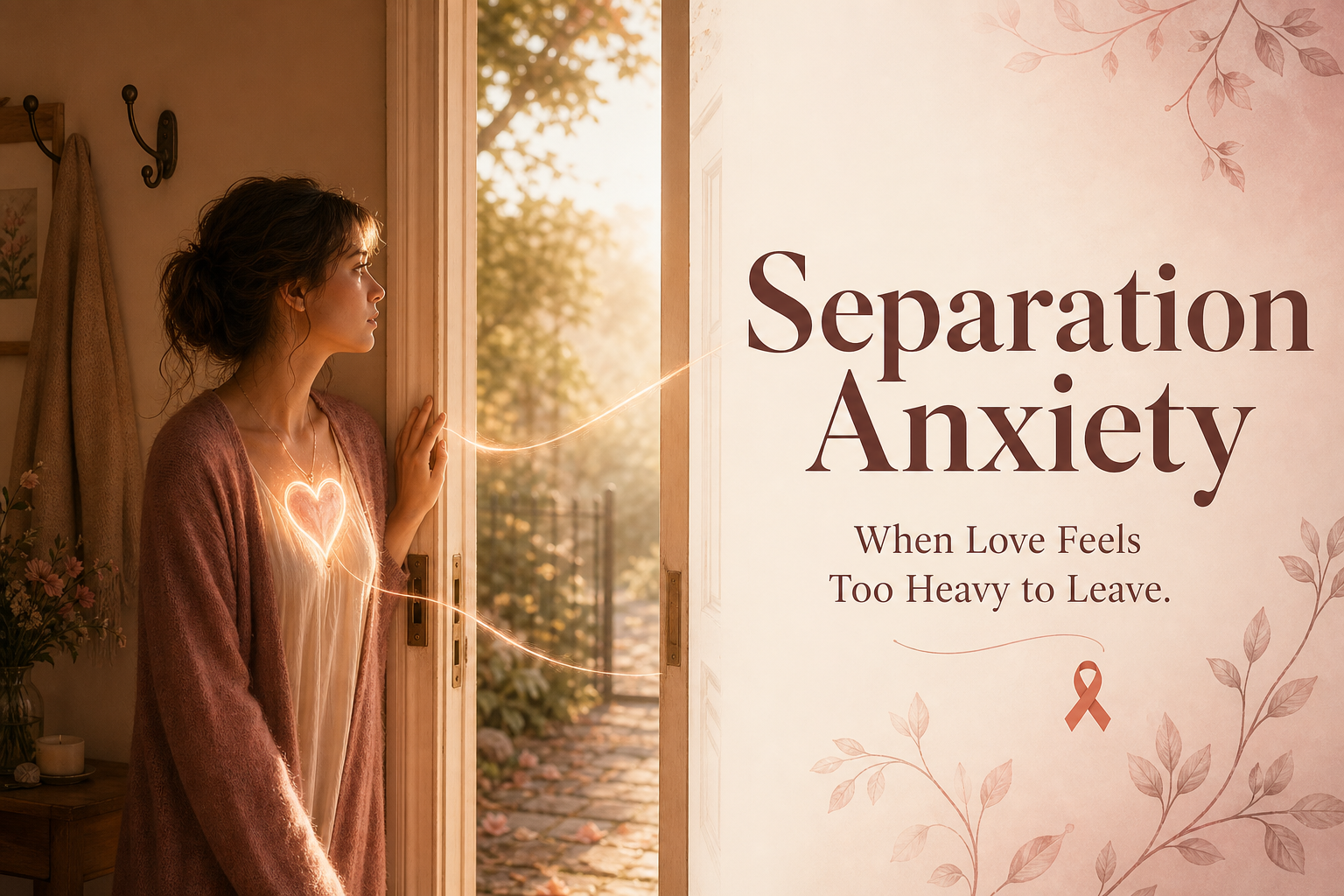
When Love Feels too Heavy To Leave
Some fears settle quietly into the body, whispering without sound, shaping the way we move through the world.
Separation Anxiety Disorder is like this — an ever-present knot in the chest when we are apart from those we love.
It is not simply missing someone.
It is a deep, living worry, a pulse of unease that can make ordinary moments — leaving the house, going to school, traveling — feel impossible.
It may begin softly, almost unnoticed.
A tightening in the stomach before stepping out.
A racing heart at the thought of being alone.
Thoughts spiral: “What if something happens? What if they need me?”
Sometimes it follows a loss, a shock, or a change in life.
Sometimes it is quietly woven into who we are.
Yet this is not weakness.
It is the heart and mind asking to be seen, understood, and held with care.
Understanding the Experience
Separation anxiety is more than fear of leaving.
It is the nervous system and the heart over-alert, holding onto imagined danger as if it were real.
It touches every part of life — the body tightens, the mind races, sleep falters, appetite wavers.
Even brief separations feel monumental, and the anticipation can be heavier than the moment itself.
From a homeopathic perspective, this anxiety is a signal.
The vital force is sensitive, protective, and deeply attuned.
It is not blameworthy.
It is a cry for safety, trust, and gentle guidance.
How It Feels
Living with separation anxiety can feel like standing at the edge of a cliff, every step away from love weighted with fear.
Physically, the body trembles, the chest tightens, the stomach churns.
Emotionally, the heart aches, worry loops endlessly, and a shadow of dread lingers.
Even brief partings — stepping outside for a few minutes — can feel unbearable.
For children, it may show as tears, clinging, or refusal to be apart.
For adults, it may appear as constant checking, overthinking, or hesitation to leave home.
Every moment of fear is real.
Every pang of longing or worry is valid.
All of it deserves patience, understanding, and tender care.
Why It Happens
Homeopathy sees separation anxiety as arising from a combination of inherited sensitivity, early life experiences, emotional responsiveness, and nervous system tendencies.
It is not weakness, over-dependence, or lack of courage.
The body and mind are responding in the only way they know — seeking safety, closeness, and reassurance.
The Homeopathic Understanding: Nurturing Trust
Homeopathy works with the whole person — mind, body, and spirit.
It helps the nervous system find calm, the heart feel secure, and the vital force regain confidence.
Remedies are selected individually, honoring the person’s temperament, fears, bodily sensations, sleep, and emotional patterns.
The goal is not to erase attachment or care.
It is to reduce the intensity of fear and restore a sense of freedom.
Some remedies a trained homeopath may consider include:
- Aconitum Napellus – for sudden, intense panic or dread at being apart from loved ones.
- Argentum Nitricum – for anticipatory worry, nervous tension, and fear about safety.
- Pulsatilla – for tearfulness, clinginess, and emotional sensitivity.
- Ignatia – for anxiety following grief, loss, or emotional upheaval.
- Gelsemium – for trembling, weakness, or panic when separated.
Each remedy is chosen to speak to the individual’s unique experience, honoring their rhythm, needs, and sensitivity.
Gentle Daily Care
Living with separation anxiety requires tenderness, small steps, and self-compassion:
- Begin with gentle, manageable separations, gradually increasing confidence.
- Keep predictable routines to reduce uncertainty and provide stability.
- Offer reassurance, but allow space for independence and growth.
- Practice calming exercises — slow breathing, mindfulness, gentle movement.
- Celebrate each small success — leaving the room, stepping outside, taking a moment alone.
Every small step is meaningful.
Every act of courage deserves recognition.
Living with Compassion and Patience
Separation anxiety teaches us that attachment is human, and fear is a signal, not a flaw.
It reminds us that even when the heart feels heavy, the mind is alert, and the body is tense, each moment of care and courage matters.
You are not defined by your fear of being apart.
You are defined by the care, patience, and love you bring to yourself and others every day.
Healing is not about erasing attachment.
It is about nurturing trust, fostering confidence, and moving gently through life — quietly, patiently, tenderly, and fully human.


Leave a Reply